
The Inconvenient Math Behind Every Buying Decision (And Why Most Experts Are Getting It Wrong)
The trust gap between your offline authority and your online invisibility — and exactly how to close it.

This should be paid but…
EVERY business owner needs to read this…If you’ve been showing up on social media, posting consistently, maybe even running ads, and still feeling like nothing is actually working, I want you to read this slowly. Because what I’m about to share might be the most important shift in how you think about your marketing.
It’s not your offer.
It’s probably not your content.
And you’re almost definitely not following up too much. If anything — you’re not following up nearly enough.
The real problem? Your audience hasn’t consumed enough of YOU yet to trust you. And without trust, there is no sale. Period.
The Story We Tell Ourselves
Here’s what happens to so many established experts, people with decades of real world credibility, transformational client results, and a level of expertise that should make them the obvious choice in their market.
They show up online. They put content out. They try different strategies. Nothing converts. So they start making up stories.
Maybe my offer is wrong. Maybe I’m on the wrong platform. Maybe I’m posting too much and annoying people. Maybe what works offline just doesn’t translate here.
And then they either blow up everything they’ve built and start over, or they quietly go back to relying on referrals and hope that’s enough.
But here’s the truth nobody is telling them.
They’re not failing. They’re just not hitting the numbers.
Trust Is The Only Currency That Actually Converts
Here’s something that nobody in the marketing world talks about honestly enough.
Trust offline and trust online are not the same thing.
If you’ve spent 20, 30 years building a reputation in your industry — walking into a room and commanding it, getting referrals because your work speaks for itself, having people vouch for you before you ever open your mouth — that trust is real. It’s earned. And it is absolutely your greatest asset.
But online? That trust doesn’t transfer automatically.
And that’s not an indictment of you or your expertise. It’s just how the digital world works. Online, nobody can feel your energy in a room. Nobody gets referred to you by a mutual friend before they find your profile. Nobody has watched you deliver results up close before they decide to reach out.
What they have is your content. Your presence. Your consistency. The accumulation of encounters with you across multiple contexts over time.
We are also living in what I call the distrust era. Consumers are more skeptical than they have ever been. AI generated content is everywhere. Over polished brands feel fake. People are drowning in 8,000 to 10,000 marketing messages every single day and their default setting is distrust until proven otherwise.
Which means the bar for earning trust online is higher than it’s ever been.
And yet most established experts are still marketing like it’s 2015. Post a few times a week. Hope the right people see it. Wait for the DMs to roll in.
That’s not a trust building strategy. That’s a wish.
Real trust online is built through volume of exposure, depth of connection, and consistency of presence across multiple environments over time. It’s not built in a day. It’s not built from one viral post. And it’s definitely not built from a text post that takes 20 seconds to read.
The good news? Once you understand the math behind how trust actually gets built online — you stop leaving it to chance and you start engineering it deliberately.
That’s exactly what the 7-11-4 Visibility Rule is. It’s not just a marketing framework. It’s a trust engineering formula. And it changes everything.
The Marketing Math Behind Every Buying Decision
As a marketing agency we have studied, tested, and built entire client ecosystems around one fundamental truth — buyers don’t make decisions randomly. There is actual math behind the moment someone decides to trust you enough to invest.
And once you understand this math, everything about how you show up online changes.
Known as the 7-11-4 Visibility Rule… It’s the foundation of every marketing system we build for our clients and it’s something I’m deeply passionate about teaching because when established experts finally see it, they stop blaming themselves and start building with intention.
Here’s what it means:
7 — hours of content consumption 11 — meaningful one on one touch points 4 — different platforms or environments
These are minimum numbers. Based on what we’re seeing right now with in today’s market, AI content saturation, 8,000 to 10,000 marketing messages hitting your audience every single day, and the distrust era we are living in, these numbers are likely even higher.
But let’s start here because most businesses aren’t even close to hitting these minimums. And once you understand why, everything starts to make sense.
Let’s Do The Math
I want to paint a really real picture for you because this is where it gets eye opening.
On most social media platforms only 2 to 3% of your audience sees any given post at one time. Not your whole audience. Two to three percent.
So if you have 2,000 connections on your Facebook personal profile, which is actually a really solid number, only about 40 to 60 people are seeing each post you put out. Not 2,000. Forty.
Now let’s say you’re posting three times a week on Facebook and LinkedIn. And let’s say those posts are text posts with an image — which take about 20 seconds to read.
I need you to do this math with me.
Your audience needs 7 hours, that’s 420 minutes, of content consumption to build enough trust to buy from you.
At 20 seconds per text post, a single person in your audience would need to read 1,260 of your text posts to hit 7 hours of consumption.
At three posts a week that’s roughly eight years.
Eight. Years.
I’m not saying this to make you feel hopeless. I’m saying this because THIS is why posting more text posts is not the answer. The problem was never your consistency. It was your content format.
Why Long Form Video Changes Everything
This is why I am obsessed with long form video as the anchor piece of content in any marketing ecosystem. And I mean obsessed. I can say with complete honesty that the online revenue I’ve built would not exist without it.
Here’s why it works so much faster.
Let’s say you do one long form live or recorded video per week — even just 15 to 20 minutes. Your audience consumes an average of 15 minutes per video. That’s 15 minutes of trust building in a single sitting. Stack four of those in a month and one person has consumed 60 minutes of you in 30 days.
Now layer in repurposing. Because that one video doesn’t just live as a video.
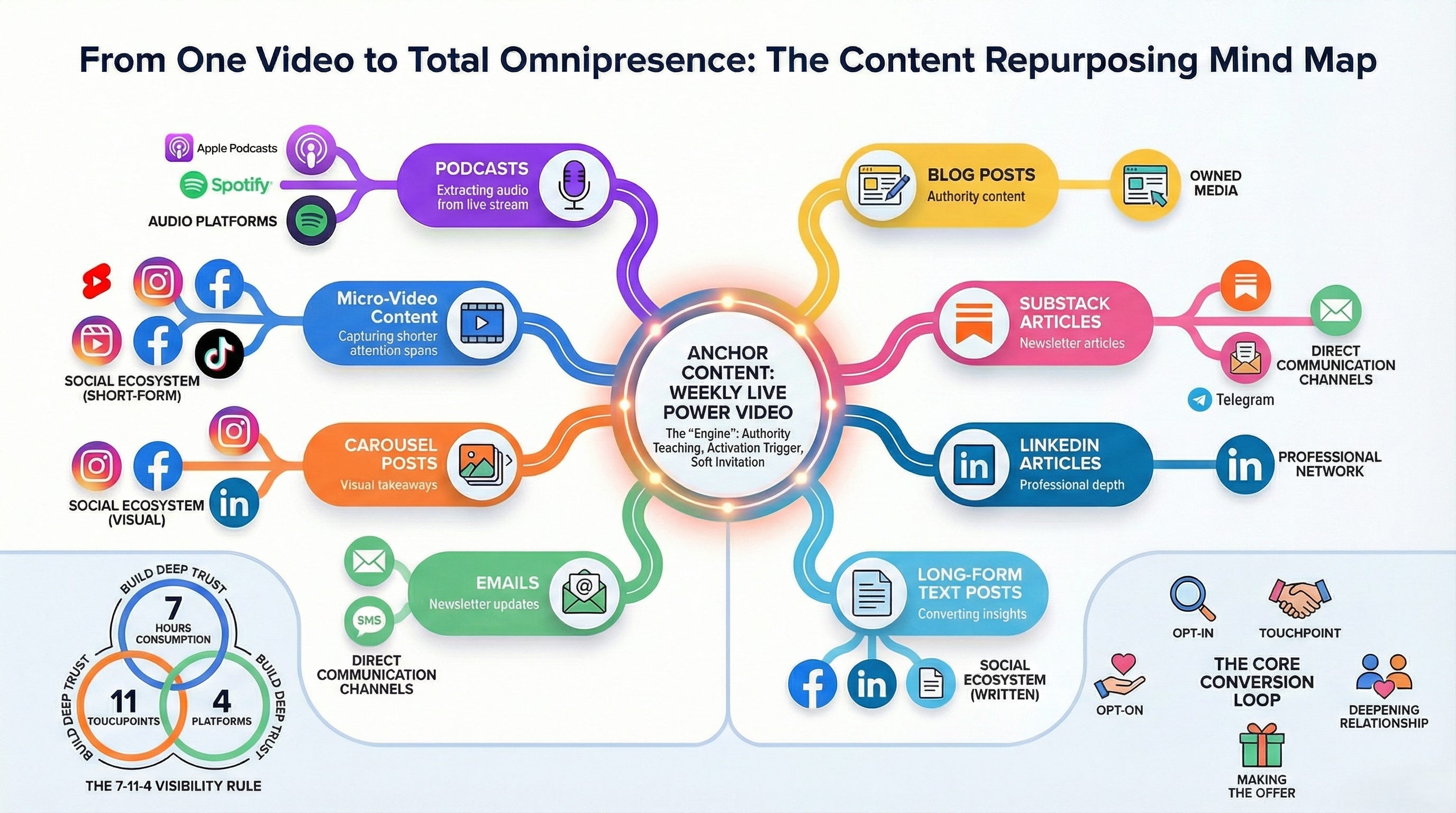
That one piece of content becomes short clips for Reels and Stories, an email campaign to your list, a LinkedIn article, a Substack piece, a YouTube video, carousel posts, long form text breakdowns. One video. Multiple formats. Multiple platforms.
And here’s the important distinction, repurposing your content this way is primarily building toward your 7 hours of consumption and showing up across 4 platforms. It creates the environmental reinforcement your audience needs to keep encountering you in different contexts.
All of that content working together also contributes to activating your audience toward those 11 touch points, but the real accelerator for touch points is something different entirely. More on that in a moment.
The 11 Touch Points People Miss
Here’s where I want to be really specific because this is the piece most marketing strategies completely skip — and it’s the one that makes the biggest difference.
The 11 touch points that actually move people through a buyer’s journey are not passive impressions. They’re not someone scrolling past your post. The ones that truly fast track the process are one on one direct interactions. Personal. Human. Real.
Think about what that actually looks like:
A DM conversation where you genuinely ask how they’re doing. A personal email reply that shows you actually read what they sent. An SMS message that says “hey I was thinking about you and wanted to share this.” An actual phone call — yes I still pick up the phone and have real conversations and it works every single time. A Zoom call where they get to see your face and feel your energy. A voice note that lets them hear your personality. A thoughtful comment that shows you paid attention.
These are the touch points that compress timelines. These are the moments that make someone go from lurking silently for weeks to DMing you saying “I’m ready.”
And yet what most established experts do is send one email, get no response, and decide that person isn’t interested. Or they send one DM and when there’s no reply they tell themselves they’re being annoying.
You’re not being annoying. You’re being forgotten. There’s a difference.
People are distracted. They mean to respond. Life gets in the way. Your job is to keep showing up with intention because the data tells us that 30, 60, even 90 days can pass between someone entering your pipeline and actually converting. That’s not failure. That’s the buyer’s journey doing exactly what it’s supposed to do.
Buyers are built. They are not triggered.
The Four Platforms — And What That Actually Means
Quick clarification because I see this misunderstood constantly.
Four platforms does not mean four social media platforms. Please do not go sign up for TikTok, Pinterest, Threads AND Instagram just because you read this.
Four platforms means four environments where your audience can encounter you. That could be Instagram, your email list, your podcast, and Zoom calls. Or Facebook, SMS, YouTube, and your blog. The goal is environmental reinforcement — your audience bumping into you in multiple contexts so that the familiarity compounds faster.
When someone sees you on LinkedIn, then gets your email, then hears you on a podcast, then receives a personal DM from you — they may collect three or four touch points in a single week instead of just one. That compresses the timeline from 90 days to 30. That’s the power of platform layering done intentionally.
What Happens When You Add Strategic Paid Traffic
Now here’s where it gets really exciting.
Everything I’ve described so far is organic. And it works. But when you layer low budget strategic paid traffic on top of a system that’s already working — we’re no longer talking months to hit the marketing math.
We’re talking days to weeks.
Here’s why. Paid traffic, specifically retargeting, allows you to put your content directly in front of people who have already shown interest.
They watched your video.
They visited your profile.
They opened your email.
They’re warm.
They know who you are.
And now your ad is showing up in their feed again, adding another touch point, another layer of consumption, another environmental encounter.
Done right, a small retargeting budget of even $5 to $10 a day can compress a 90 day buyer journey into 2 to 3 weeks. Not because you’re rushing them, because you’re intentionally engineering the exposure density they need to feel certain.
This is why we no longer take on paid traffic clients without also managing their organic. Because paid traffic amplifies what’s already there. If the organic system is solid, paid traffic pours fuel on the fire. If it isn’t, you’re just accelerating the leak.
What This Looks Like In Real Life: Duncan’s Story
I want to tell you about our client Duncan. He came to us with 30 years of experience in his industry. Decades of offline credibility. A track record that should have made him impossible to overlook.
Online? He was completely invisible.
No social media presence. A bare LinkedIn profile with just his name and photo. No content strategy. No lead generation system. 100% dependent on referrals with no control over his pipeline. And he’d never once used video.
He wasn’t looking to go viral. He wasn’t trying to become an influencer. He wanted a professional strategic system that positioned him as the obvious choice for high caliber clients.
So we built him a complete Visibility to Profits™ Ecosystem from the ground up.
We started with his positioning, nailing down exactly who he is, who he serves, and why they should choose him over anyone else.
Then we built his visibility strategy, his content system, his lead generation infrastructure, and his sales process.
Within just a couple of months of consistently showing up, the system started working. Organic leads began coming in from Facebook and YouTube. The marketing math was building momentum.
Then came the moment that still gives me chills.
Seven days. That’s how long it took from a LinkedIn connection request to a signed $125,000 annual retainer.
Day 1 — connection request accepted. Day 2 — DM conversation started. Day 3 — call scheduled. Day 5 — call held. Day 7 — contract signed.
Shortly after he closed two more clients. Then he added paid traffic to accelerate the lead flow even further.
And then we had to turn his ads OFF.
His pipeline was so full, so overflowing with qualified inbound leads, that he’s now hiring a team just to handle the volume.
Duncan didn’t go viral. He didn’t reinvent himself. He didn’t post five times a day. He got the right system and he let the marketing math do its job.
He went from invisible to in-demand in 6 months.
This Is The
System
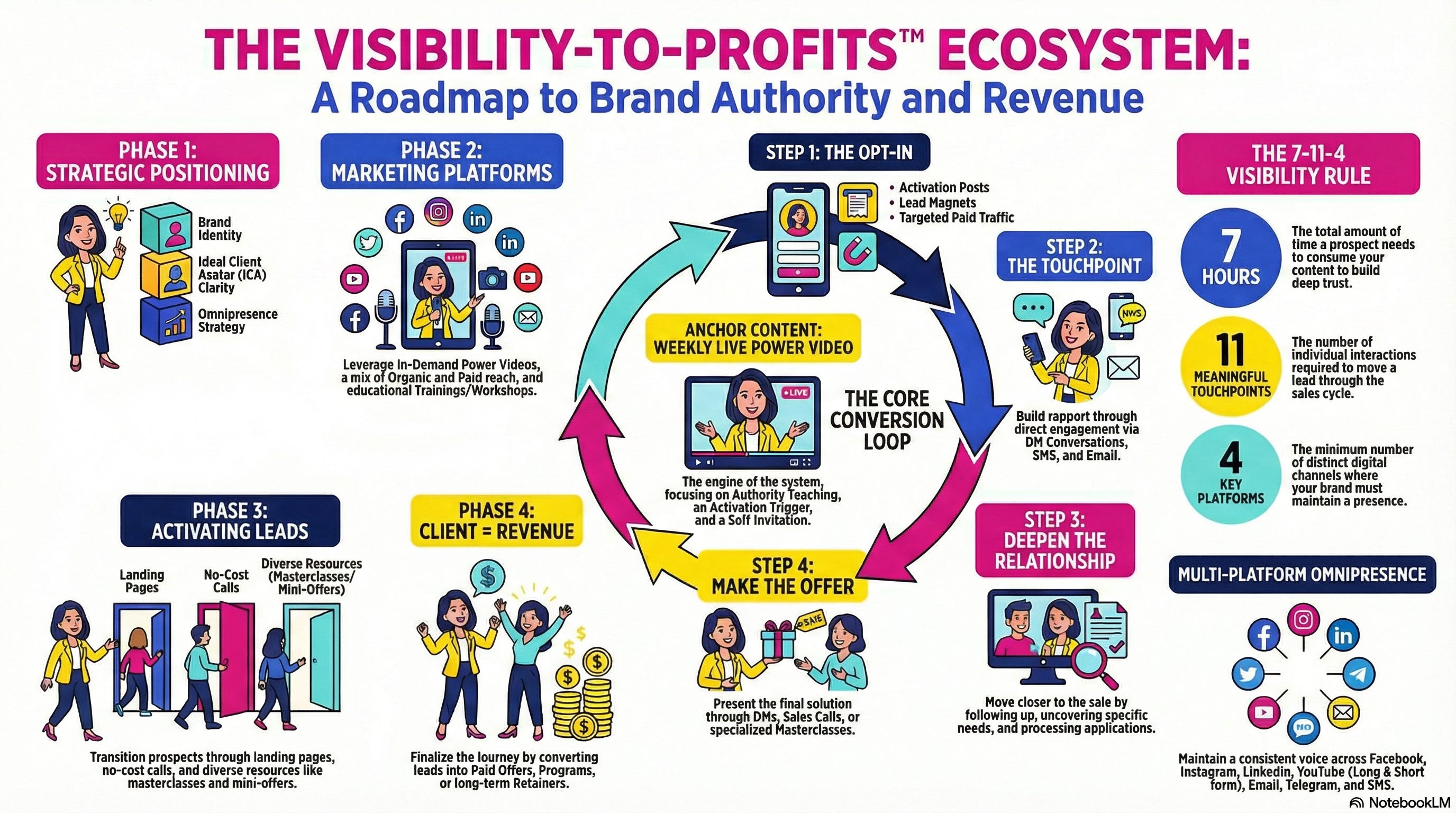
What I’ve just walked you through isn’t theory. It’s the foundation of the Visibility to Profits™ Ecosystem we build with and for our clients every single day. Four phases. One connected system.
Phase 1 — Strategic Positioning: Who you are, who you serve, why they choose you.
Phase 2 — Strategic Visibility: Where you show up, how often, what you say. Phase 3 — Activating Leads: How to turn visibility into real conversations.
Phase 4 — Client = Revenue: How to turn conversations into clients and revenue.
It’s not magic. It’s math. And once you see it that way, you stop reacting and you start building.
Consistency isn’t optional. It’s mathematical. You’re not repeating yourself. You’re increasing probability.
So What Do You Do With This?
Three things. Right now.
First — audit your content hours. If someone found you today how many hours of valuable content could they immediately consume? If the answer is less than three to five hours of accessible content, you are underexposed. The goal is a minimum of seven hours of content available at any given time.
Second — map your touch points. How many personal one on one interactions are you actually creating every week? DMs. Emails. Calls. Voice notes. SMS. If your ecosystem is only creating three to four passive impressions over 30 days you are starving the buyer’s journey.
Third — check your platforms. Are you showing up in at least four meaningful environments? Not four social media accounts. Four different ways your audience can consume and interact with you.
If you’re operating at a two, a three, and a one, now you know why it feels so slow. You don’t need a new offer. You need engineered visibility.
If you read this and thought “I think my marketing has some leaks”, you’re probably right. I offer complimentary mini marketing audits for established experts and personal brand CEOs who are ready to stop guessing and start building a system that actually works. Grab a spot on my calendar HERE.
And if this resonated, share it with someone who needs to hear it, especially your team if you have one! This is exactly the kind of conversation that changes businesses.